Screenshot 2020 10 07 114340

Easy Ways To Go Zero Waste At Home

Zero waste living aims to minimise the impact of modern life by reducing the amount of waste we produce. It’s said that the average Australian produces 540kg of waste per year so it can seem daunting to imagine not producing any waste of any kind.

Going zero waste is definitely not going to happen overnight but if there’s one thing we can do for the planet, it’s to reduce the amount of waste we produce. Especially in our own homes. There are some really easy steps you can take to move towards a zero-waste home, so we’ve put together a list of some easy and budget-friendly ideas below to get you started.

Remember, it’s not about being perfect. Small changes which we make collectively can make a big impact so pick a couple that is achievable for you and implement these in your home today.

EASY WAYS TO GO ZERO WASTE AT HOME:

  1. Separate your rubbish

The first step to zero waste is separating your rubbish properly. Without this, you might be sending waste to landfills which could actually be recycled or composted or contaminating your recycling so it has to be sent to landfills. Contaminated rubbish affects what will and won’t be sent to recycling.

An easy way to do this is to install four bins at home. One for landfill (e.g. non-recyclable plastics, household waste), one for recycling (e.g. paper, glass, cans, card), one for soft plastics (e.g. any plastic your can fold in your hand) and one for compost (e.g. food waste). Your number one goal at home is to use the landfill bin the least. 

It’s always a good idea to give any glass jars, can or packaging a rinse and let dry on your dish rack overnight to remove any food which might contaminate your recycling.

Some councils will take away your soft plastic but, if not, there are soft plastic drop-off bins at both Coles and Woolworths.

  1. Recycle glass jars

Glass jars can be used for so many things around the house and that’s not just making your own jam. Save and wash all of your empties and use next time you head to the bulk food store, regrowing your food scraps, pickling food for long term storage, storing leftovers in the fridge or taking to work, new cocktail glasses and food storage. Plus, the right jars can make your kitchen shelves and pantry look beautifully coordinated and organised.

  1. Invest in reusable food and drinks containers

One the easiest ways to reduce your waste is by storing your food properly, so it’s important to invest in reusable food and drink containers. Glass jars can be great for storing your coffee, nuts, smoothies, dried foods and pulses, but it’s a great idea to also invest in some natural, reusable containers like Pyrex-style glass dishes,  stainless steel bento boxes or silicone lids which you can use for meal prepping or saving your leftovers.

  1. Compost your food waste

A compost bin is a great addition to your kitchen or garden. There are some really good options out there for cheap and easy to implement composting options for your garden, and there are also clean, tabletop versions which you can keep in your kitchen available or community bins in your local area. Worm farms are ideal for those with limited space as they fit neatly on a balcony. 

  1. Use food scraps to make your own cleaning products

Food can be used for really effective cleaning products. Ingredients like distilled white vinegar, lemon juice, baking soda and sugar can be used to polish kitchen worktops, clean windows and remove stains whilst killing that pesky bacteria. Combine these with essential oils for a beautiful smelling home.

  1. Swap tea-bags for tea leaves

I don’t know about you but we average upwards of 5 cups of tea each per day, every day. That equates to almost 2,000 tea bags in our landfills per person in a year! Some teabags are made from, or sealed using plastic which not only sheds billions of particles of microplastic into each cup you drink but also end up in our landfills. To reduce this, swap your tea bags for tea leaves in a metal strainer instead. The tea leaves are often better quality too, so it’s really a win-win.

  1. Repair holes in clothes

It may sound obvious, but too often clothes are thrown away for having small holes, a broken zipper or a lost button even though these can be sown up very easily, without the need for any seamstress skills. Make an excuse to visit an older relative and ask them for tips if you’re really stuck, it’ll be a great bonding experience which you’ll find therapeutic.

  1. Ditch disposable for natural materials

There are some really great natural fibres on the market which provide brilliant and budget-friendly alternatives to disposable products like bamboo cotton pads, metal razors, natural loofah’s, plastic-free q-tips, natural tampons, cloth face wipes.

  1. Save food scraps for homemade stock and natural dyes

Food scraps can be used in a whole heap of ways like turning root veg stalks into homemade stock, apple cores and skins into apple cider vinegar, regrowing your roots, baking old bread into croutons and french toast, using banana skins for cleaning…I could go on…but one of our favourites is natural tie-dying. 

Simply using your food scraps and water, turmeric can be used to create yellow tones; red onion for pink; red cabbage leaves for purple and avocado skins for dusty pinks and browns. Plus, it’s a great way to bring life back into that white t-shirt you split red wine on!

  1. Request for no junk mail to be put through your letterbox

Another easy one, add a small sign to your front door or letterbox requesting that companies do not post you junk mail. Chances are you’re probably not interested in selling your house right now or need another plastic tradie magnet for your fridge. But when you do, you’ll open a web browser not your letterbox to find the best options.

  1. Use cloth nappies instead of disposable

A staggering 3.75 million disposable nappies are used each day in Australia and New Zealand, and it takes about one cup of crude oil to make each nappy. This is a lot for landfills, with conventional disposable nappies estimated to take up to 150 years to break down. Making a switch to cloth nappies is the more environmentally-friendly option, and is easier than ever with the modern cloth nappies currently available. You might also like to consider a cloth nappy washing service, but bear in mind the energy and emissions associated with transportation.

  1. Swap to rechargeable batteries

Never again find yourself hunting around in that draw you dump everything from pens, foreign coins, remote controls, keys that you have no idea what they open, letters you’re saving for…what was it again, random cards and pairs of glasses, for batteries again and switch to rechargeable types. Keep your batteries in two small glass jars, write ‘Flat’ and ‘Charged’ on the lids. Invest in quality rechargeable batteries and a charger. Charge a group of batteries and store in the ‘Charged’ jar, put the rest in the ‘Flat’ jar and charge as needed. When the remote goes flat, you know where to go. Thank us later.

  1. Prep!

Making meals instead of buying takeout or ready meals is a great way to reduce waste and save on all of those disposable take-away containers. You’ll use all the food you purchased at the supermarket, cut down on packaging of food items, and reduce the carbon footprint of your food while you’re at it. Dehydrators are great too for healthy snacks to store in your cupboards. Keep it really easy, and save time, by cooking food in bulk and eating it throughout the week.

What do you think of these tips? Do you have any other steps to add?

Vesica biodiversity

10 Ways to Conserve Biodiversity this Biodiversity Month

September is the National Biodiversity Month. Every year Biodiversity Month is held to advocate the importance of protecting, conserving and improving Australia’s biodiversity. 

So, what is biodiversity? Why does biodiversity matter to us? What can you do for biodiversity? 

Biodiversity means the abundance and variety of life on the planet. A biologically diverse natural environment is essential to human health, well-being and prosperity. It provides us with everything from the air that we breathe, to the water that we drink, the food that we eat and the environment we live in. Right now, biodiversity is in crisis – because of us. 

“Work with nature, rather than against it.” – every successful organic gardener, ever

Australia is one of the world’s biggest biodiversity hotspots. Still, we are losing it at an unprecedented rate, according to the Living Planet Report of 2018, which shows us a 60% fall in just over 40 years. Most of our plant and mammal species, and nearly half of our bird and marine species are endemic (Department of the Environment and Energy, 2019). 

Protecting biodiversity is one way that we all can plan for the future. We can participate in the protection of biodiversity by becoming knowledgeable about the things we buy, consume and use. How we treat the environment is also how we treat biodiversity so it’s time to stop and appreciate the web of life that surrounds and sustains us. 

Here are 10 ways that you can help to conserve biodiversity this Biodiversity Month: 

  1. HELP THE BEES! 

As pollinators, bees play a part in every aspect of the ecosystem. They support the growth of trees, flowers, and other plants, which serve as food and shelter for creatures large and small. 

Support pollinators in your backyard by planting a variety of wildflowers and native plants to provide nectar that will bloom throughout the season. 

  1. CUT PLASTIC POLLUTION 

Plastic pollution is choking every part of the world. Every year, an estimated 8 million metric tons of plastic enter our oceans — that’s one dump truck every minute. To protect biodiversity, we need to avoid plastics whenever possible, and where we cannot avoid them, then we must reduce, reuse and recycle. 

  1. PROTECT NATURAL HABITATS 

All animals and plants need suitable and high-quality habitat. That’s not to say that we can’t enjoy the habitats of animals, like national parks, wetlands and bushland but everyone has a role to play in protecting and maintaining these areas. Next time you’re out and about, try to leave habitats undisturbed by sticking to designated paths, cleaning up after yourself and not picking wildflowers.

  1. CREATE A NATURAL ECOSYSTEM IN YOUR OWN BACKYARD 

Whether you live on a farm or in an apartment in the city, you need plants, and it’s not difficult to create a garden in your own backyard which has a permaculture design. 

From kitchen gardens, orchards, zen gardens, wild areas and hedgerows, there are many different types of gardens that can be designed in ways that increase biodiversity.

Get started by researching the plants and vegetables that are local to your area and grow a variety in your own backyard. Each plant and vegetable helps to protect biodiversity and supports the broader ecosystem of your local area. 

  1. REDUCE, REUSE AND RECYCLE 

Look at ways to reduce the amount of rubbish that ends up in landfill and the waterways. Reducing, reusing, and recycling ca n help preserve biodiversity by limiting the number of resources needed to make new products. The more we can reduce our demand for new resources, the less habitat conversion will be necessary in the long run. 

  1. PURCHASE PRODUCTS THAT HAVE ECO LABEL 

Ecolabels (like a PETA certification or Green Tick) are a great way of determining which products are green, safe, and environmentally sustainable. These labels allow you to learn precisely products are made from and the percentages of the ingredients in a particular food or household cleaning items so that you can determine how much impact they have on the environment. 

  1. SUPPORT FARMERS 

Be an informed eater and purchase your food from socially and sustainably responsible growers. 

Farmers play a key role in conserving biodiversity. With the help of biotechnology and plant science, farmers can grow more food on the same amount of land. This takes the pressure off the need to convert natural habitats into farmland. 

  1. SUPPORT SUSTAINABLE ENERGY 

As we know, climate change has disastrous consequences for all living things on earth. We use huge amounts of fossil fuels, which directly cause climate change. 

If you can, choose to use alternative energy sources and natural or sustainable products in your home. This will reduce the effects of climate change and requires a worldwide effort. 

  1. WALK, RIDE, DON’T DRIVE 

Each litre of gasoline burned releases ~2.3 kg of the greenhouse gas CO2, so reducing car use is a considerable step towards protecting biodiversity. 

Where you can choose to walk instead of drive, take local transport, save errands so you can take fewer car trips and stay local at the weekend. 

10. EDUCATE 

Education is essential for the future of the planet. We depend on the global collective action of an educated society, including efforts to promote local and indigenous knowledge of biodiversity. As awareness increases, it becomes easier to incorporate eco-friendly practices into your day-to-day life, spread the word to your friends and family and influence your local government.  With even more time now being spent immersed in social media, don’t forget to share or post those positive and simple practises that can bring change to your online community at the moment.

featured image

A Personal Note and Thank you From Us

Hi Friends, 

I wanted to write you a personal note to thank you for the ongoing support you have given us during these difficult times. 

As a family-owned small business, 2020 has been an interesting year! The nation-wide ban on music festivals and local markets in Australia saw our usual haunts disappear overnight and left us feeling a little bit lost. Suddenly we were left without our retail opportunities, our customers or opportunities to spread the Vesica mission. Small businesses and artisans alike are suffering greatly under these tight restrictions.

The 6 years since I opened Vesica have been a whirlwind. What started as a passion for all things eco-friendly, and a love for making natural leather products, grew as my family grew and quickly became my livelihood. I rely on the support of amazing people like you to keep Vesica thriving as a business.

That being said, you’ll notice a few changes popping up around here. The time to focus on our little home on the web has meant that we are finally launching our newsletter! We’ll be sharing bi-monthly updates, eco-living tips, new products launches as well as exclusive discounts and offers.

We will be sharing handy tips and actionable advice for navigating eco-friendly living more regularly on the Vesica blog. Don’t forget to keep checking in over there to keep up with our latest posts. We’d love to hear your ideas for future blogs or stories of adventures you’ve had with your beloved Vesica products, so feel free to get in touch with us! 

I’m so excited to give Vesica a voice and connect with the amazing friends I’ve met along the way, who I’ve missed greatly.

We’re also taking this opportunity to give a little back and reward all of you wonderful ambassadors, and passionate promotors leading the plastic-free revolution, with the Vesica affiliate program.

If you’ve ever been complimented on your water bottle and graciously shared our details with a new friend or internet pals and then thought, ‘I really should be getting a kick-back for every person that asks me about my bottle…or tea infuser.’

Well, now you can!

Simply, sign up here, share a short link or show them a QR code to scan. Then any purchases they make can be traced back to you and we’ll pay you a %.

My super supportive customer base and quality product offering have been the building blocks that have kept Vesica standing all these years. I can’t wait to grow the Vesica family even further through the affiliate program.

There are plenty of other ways you can show your support to small businesses during this time. Of course, investing in some new products for yourself or loved ones is amazing but there are plenty of ways that you can support us without spending any money at all. These include: 

  • Writing a review on the Vesica Facebook page.
  • Following us on Instagram and liking/commenting on/sharing our posts.
  • Posting pictures of your Vesica products, using our hashtag #MyVesica
  • ….Giving #MyVesica a search and connecting with other Vesica friends.
  • Sending us a message with your love, photographs and stories of your Vesica products.
  • Subscribing to our newsletter.
  • Telling your friends and family about us!

Thank you again for choosing Vesica and for continuing your eco-friendly journey with us. Keep in touch!

Love,

Shane x

Vesica combo Byron Bay

Why We Use Leather?

Why We Use Leather?

“Leather is not vegan and eco-friendly, so how can you call yourself an eco-brand?” …We often get asked this because our signature product is handmade water bottle cases made from leather…

Being ecologically responsible and conscious of our impact on the environment is something that we are strongly passionate about here at Vesica, so we thought it was important to address some of these concerns as to why we currently use leather in our products.

As producers and consumers living in a modern first world society – we deeply resonate with the Buddhist philosophy and way of life in that we understand  and honor the preciousness and sacredness of life in all living beings. We recognize the importance of this when we choose to use leather within our products. Yes, an animal’s life was taken – and it is with reverence and gratitude that we receive this as leather to make our water bottle cases.

It is with this deep respect of the creature that was in the end of its life that we may prevent further destruction and devastation of the habitat of other innocent animals such as marine life due to the excessive plastic pollution in the ocean. From one full hide, Vesica can make over 50 water bottle cases which will be used for years and years to come. By making reusable water bottles accessible (and desirable) this encourages people to take responsibility for their consumption of water and therefore the subsequent waste production such as plastic water bottles.

There are many other ‘eco-alternatives’ to leather. Many of which are not yet commercially available and cost-effective. Some suggestions are pineapple, mushroom and kombucha skins. At Vesica, we are also passionate about creating high-quality products that will last years, if not a life-time! Our leather products are of the highest quality and can survive all conditions such as stress, heat, humidity and are water proof as opposed to water resistant like most of these other options. It also has to be structurally consistent and affordable. If a vegan option were available but at twice the cost to the customer, it doesn’t seem as a viable option does it?

There are other styles of carry cases available on the market, made from Hemp macramé and cotton. We may expand into these products in the future, but no plans at the moment as we have out sights on other eco-wares. If animal products are not your thing? our water bottles are available without cases.

Consumers know leather, they know it means quality and there’s no effort in convincing people it’s going to last. We believe leather is going to outlast any synthetic oil based imitation such as polyurethane and fake leather. As an inferior product, they destroy quickly – the outside often peels off after minor use and unlike leather which is an organic material that will bio-degrade easily at the end of its life time, synthetic alternatives aren’t recyclable. Oil based alternatives are also non-porous which causes growth of mold and bacteria,  producing bad odor & hygiene issues on the inside of the cases.

We do our best to offer value for money and guarantee all cases for 1 year. Happy to replace or fix parts to keep each case working. Vesica is not about providing obsolescent and inferior quality products to generate more income, we re-stitch and repair before replacing.

In conversation with Provenance Biofabrics (provenance.bio) who are researching and developing leather made from collagen cells. This is an extremely exciting step forward in leather alternatives; they can even grow sheets of leather to specific thicknesses and sizes. When this technology advances we will definitely embrace it. We are not interested in using oil based materials.

Whilst we seek out viable alternatives to leather in the meantime, we remain dedicated to reducing plastic waste by providing a high quality substitute to the plastic water bottle.

In addition, the current state of the meat industry is unfortunately still causing tremendous issues for our environment. It is an industry continually striving to increase demand for meat and profits each year and with this, comes leather as a bi-product. Our questions is – how do we continue to reduce demand for animal products, whilst still remaining true to our commitment to reduce waste? – so what would happened to all the hides of all those cows?

If Vesica stopped making leather cases it would hardly affect this market and we’re such a small fraction of this bigger picture. “But supply follows demand.” you might say…this is true…and in this instance, the demand is not for the leather products, it is for meat. So by purposing a by-product of a wasteful industry, we are helping to offset the eventual excess by putting this material to good use.

We source our leather as sustainably as possible. The lacing we use is kangaroo leather, the strongest leather in the world. In Australia, kangaroo meat is processed for consumption which is known for its leanness and tender taste. It has been a staple source of food for our Indigenous culture for 60 000 years. The kangaroos are culled because of over population in Queensland and hides are processed to strict Australian guidelines.

We use buffalo leather for our shoulder straps which comes from India from buffalo that have been raised for working fields, milk, meat consumption and finally leather.

Our Deluxe range of cases are made using veg tan leather. This type of leather is the most natural due to there being no toxic color dyes used in the production process. We do the hand staining of the cases using eco-dyes.

Roughly 90% of the coloured chrome and suede leather used is 2nd cuts or recycled leather. We prefer to use what others consider waste and give it a new life as a treasured case, that will be used for years to come.

At Vesica we choose very selectively the leather for our cases.

Furthermore, so much of what we use and consume in this modern society comes with an environmental impact – which can become absolutely overwhelming and daunting when you really look at this in more detail and start to think of possible alternatives and different solutions to the environmental degradation we are experiencing in this age. Take for instance the computer this is being typed on, the devices we stare at every day, the cars we drive, the paint on our walls, the toxins in the air, the transport industry, the food we eat – and so on. It’s enormous! Therefore we believe it’s important to do the absolute best you can with where you’re at and with the means that you’ve got. You’ve got to pick and choose your battles as well otherwise we’d all just completely burn out trying to rid this planet of all the harmful properties known.

So for now, with where we’re at, our big battle is plastic pollution and finding better sustainable solutions for every-day use materials and items. Taking new steps each day to extend this eco-friendly reach further and further – like seeking other eco-friendly products to make available to our customers, being socially active in the eco-conscious sphere and beyond and having a conscious voice within our community to make a lasting impact.  We’re trying our best here at Vesica to discourage people using disposable water bottles everyday along with other nasty plastic products.

In  the long run – Vesica does not intend to be a leather-goods supplier. We are now expanding into more bamboo, LED lighting, hemp and other eco-friendly products to be launched in the near future.

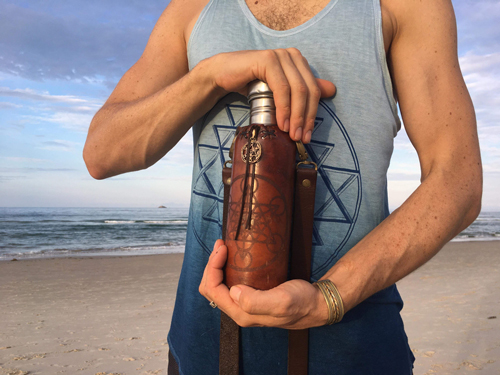
The leather case is a beautiful way to individualize everyone’s water vessel, an important tool in ones life. Any owner of a Vesica knows how handy it is having water on a sturdy strap over your shoulder, making it accessible and reusable.

It is a dream to support a small bio-dynamic farm to raise the cows for all the leather needed to produce the cases per year.

As the maker of Vesica products, I’ve always used leather belts and leather shoes because of its quality. I was a vegetarian for over 10 years and now consume a small amount of meat in my diet. I absolutely support people who choose to go on a vegetarian or vegan diet for ethical reasons.

The leather’s surface provides me with a beautiful canvas for me to create my art, to add totems and sacred patterns to spread a divine vibration of consciousness across our planet. Through connecting these sacred geometrical patterns into the molecular structure of our drinking water, we are helping to recalibrate our human consciousness to our Mother Earth…Pachamama.

Shane

Disposable coffee cup plastic pollution

How To Say Goodbye To Disposable Coffee Cups Once And For All

It takes us just a few minutes to drink a cup of coffee on the go. We buy it, sip it, discard it, and go on with our day. The cup is only a few moments into its miserable existence when we chuck it in the paper-and-lid graveyard all bins seem to become during inner city mornings.

Those cups are not recyclable. Nor are the hundreds of other cups you see in people’s hands as they walk down the street. No matter how cardboardy it looks it’s dead by the time it leaves your hand, destined to spend hundreds of years in a landfill.

The reason? Inside every cup is a plastic lining that makes the whole thing almost impossible to recycle; it can’t be decomposed but will remain a danger to the ecosystem and the animals for as long as it exists. Even biodegradable and waxed disposable cups hardly ever end up at the recycle stations simply because they are so hard to tell apart from the rest. Most places also don’t have the infrastructure to deal with them.

Styrofoam cups aren’t any better, as they can’t be recycled and stays in landfills for about 500 years!

Even if we found a way to recycle disposable cups, would it really be worth it? They need resources. Lots of them. After washing, pulping, and processing 98 tonnes of materials, only one tonne of paper remains suitable for coffee cup creation. And that’s just the paper. Creating plastic from crude oil is an incredibly energy consuming process.

Those are resources that we throw out after just a single use.

The solution has been around for a while. It’s simple, cheap, it’s super sexy, it seals, and convenient. It has won over more and more people during the last couple of years. It’s almost too obvious, too easy, too good to be true.

We are of course talking about the reusable coffee cup. If you want to make a difference today, the Vesica tea infuser meets the need of any environmentalist. Its insulated stainless steel chamber is covered in a beautiful bamboo wood and seals tight to keep the heat or coldness locked in for hours. It comes in a convenient 300ml size that can easily fits in your bag or even large (back) pockets and wont spill a drop. It’s insulated and also includes a strainer for your tealeaves, brew your tea as per the instructions. The basket clips down securely allowing you to put leaves underneath for a stronger brew, without the basket falling out.

However even with this solution available, most people still prefer the disposable cups. In fact, Australians use 113 of them every four seconds.

Most of you out there will feel motivated to stop using disposable coffee cups for a while after reading this blog post. You will sit in instead of take away, or bring a cup with you around. What happens afterwards is that most people slowly fall back into their old habits. When the first impact of the information has started to wear off, and everyone around us is using disposable coffee cups anyway, maybe even mocking the clear conscience keep cuppers, it’s hard to stay motivated.

In order for us as an evolving planet/polluting population to embrace the change we know needs to happen, create a good habit and takeaway the takeaway coffee cup from your life. Could you do it?

Standing out and being a lone fish swimming against the current is too mentally exhausting. Consumer psychologist Paul Harrison says that “Even if we have environmental beliefs, it takes risk-taking behaviour to step outside of social norms”.

That’s why it’s so important to embrace the challenge of change, and be together about it. With the versatile Vesica tea infuser, you can signal to other environmentalists that they are not alone, and also feel supported when you see someone else carrying one. Be proud of the courage you show when you use a reusable cup. There are many people out there like you.


Mette

http://www.carryyourcup.org/

http://about.abc.net.au/war-on-waste-fixing-your-coffee-fix/

https://www.choice.com.au/food-and-drink/drinks/tea-and-coffee/articles/are-takeaway-coffee-cups-recyclable

https://www.vesica.com.au/shop/tea-infuser/