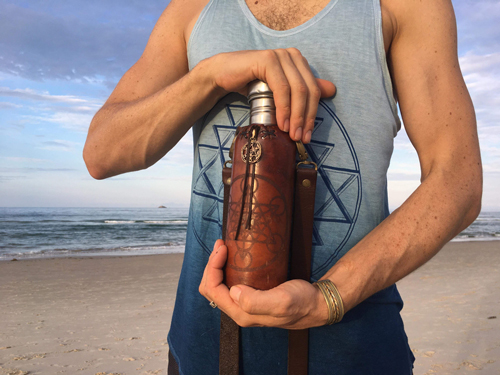
Why We Use Leather?
“Leather is not vegan and eco-friendly, so how can you call yourself an eco-brand?” …We often get asked this because our signature product is handmade water bottle cases made from leather…
Being ecologically responsible and conscious of our impact on the environment is something that we are strongly passionate about here at Vesica, so we thought it was important to address some of these concerns as to why we currently use leather in our products.
As producers and consumers living in a modern first world society – we deeply resonate with the Buddhist philosophy and way of life in that we understand and honor the preciousness and sacredness of life in all living beings. We recognize the importance of this when we choose to use leather within our products. Yes, an animal’s life was taken – and it is with reverence and gratitude that we receive this as leather to make our water bottle cases.
It is with this deep respect of the creature that was in the end of its life that we may prevent further destruction and devastation of the habitat of other innocent animals such as marine life due to the excessive plastic pollution in the ocean. From one full hide, Vesica can make over 50 water bottle cases which will be used for years and years to come. By making reusable water bottles accessible (and desirable) this encourages people to take responsibility for their consumption of water and therefore the subsequent waste production such as plastic water bottles.
There are many other ‘eco-alternatives’ to leather. Many of which are not yet commercially available and cost-effective. Some suggestions are pineapple, mushroom and kombucha skins. At Vesica, we are also passionate about creating high-quality products that will last years, if not a life-time! Our leather products are of the highest quality and can survive all conditions such as stress, heat, humidity and are water proof as opposed to water resistant like most of these other options. It also has to be structurally consistent and affordable. If a vegan option were available but at twice the cost to the customer, it doesn’t seem as a viable option does it?
There are other styles of carry cases available on the market, made from Hemp macramé and cotton. We may expand into these products in the future, but no plans at the moment as we have out sights on other eco-wares. If animal products are not your thing? our water bottles are available without cases.
Consumers know leather, they know it means quality and there’s no effort in convincing people it’s going to last. We believe leather is going to outlast any synthetic oil based imitation such as polyurethane and fake leather. As an inferior product, they destroy quickly – the outside often peels off after minor use and unlike leather which is an organic material that will bio-degrade easily at the end of its life time, synthetic alternatives aren’t recyclable. Oil based alternatives are also non-porous which causes growth of mold and bacteria, producing bad odor & hygiene issues on the inside of the cases.
We do our best to offer value for money and guarantee all cases for 1 year. Happy to replace or fix parts to keep each case working. Vesica is not about providing obsolescent and inferior quality products to generate more income, we re-stitch and repair before replacing.
In conversation with Provenance Biofabrics (provenance.bio) who are researching and developing leather made from collagen cells. This is an extremely exciting step forward in leather alternatives; they can even grow sheets of leather to specific thicknesses and sizes. When this technology advances we will definitely embrace it. We are not interested in using oil based materials.
Whilst we seek out viable alternatives to leather in the meantime, we remain dedicated to reducing plastic waste by providing a high quality substitute to the plastic water bottle.
In addition, the current state of the meat industry is unfortunately still causing tremendous issues for our environment. It is an industry continually striving to increase demand for meat and profits each year and with this, comes leather as a bi-product. Our questions is – how do we continue to reduce demand for animal products, whilst still remaining true to our commitment to reduce waste? – so what would happened to all the hides of all those cows?
If Vesica stopped making leather cases it would hardly affect this market and we’re such a small fraction of this bigger picture. “But supply follows demand.” you might say…this is true…and in this instance, the demand is not for the leather products, it is for meat. So by purposing a by-product of a wasteful industry, we are helping to offset the eventual excess by putting this material to good use.
We source our leather as sustainably as possible. The lacing we use is kangaroo leather, the strongest leather in the world. In Australia, kangaroo meat is processed for consumption which is known for its leanness and tender taste. It has been a staple source of food for our Indigenous culture for 60 000 years. The kangaroos are culled because of over population in Queensland and hides are processed to strict Australian guidelines.
We use buffalo leather for our shoulder straps which comes from India from buffalo that have been raised for working fields, milk, meat consumption and finally leather.
Our Deluxe range of cases are made using veg tan leather. This type of leather is the most natural due to there being no toxic color dyes used in the production process. We do the hand staining of the cases using eco-dyes.
Roughly 90% of the coloured chrome and suede leather used is 2nd cuts or recycled leather. We prefer to use what others consider waste and give it a new life as a treasured case, that will be used for years to come.
At Vesica we choose very selectively the leather for our cases.
Furthermore, so much of what we use and consume in this modern society comes with an environmental impact – which can become absolutely overwhelming and daunting when you really look at this in more detail and start to think of possible alternatives and different solutions to the environmental degradation we are experiencing in this age. Take for instance the computer this is being typed on, the devices we stare at every day, the cars we drive, the paint on our walls, the toxins in the air, the transport industry, the food we eat – and so on. It’s enormous! Therefore we believe it’s important to do the absolute best you can with where you’re at and with the means that you’ve got. You’ve got to pick and choose your battles as well otherwise we’d all just completely burn out trying to rid this planet of all the harmful properties known.
So for now, with where we’re at, our big battle is plastic pollution and finding better sustainable solutions for every-day use materials and items. Taking new steps each day to extend this eco-friendly reach further and further – like seeking other eco-friendly products to make available to our customers, being socially active in the eco-conscious sphere and beyond and having a conscious voice within our community to make a lasting impact. We’re trying our best here at Vesica to discourage people using disposable water bottles everyday along with other nasty plastic products.
In the long run – Vesica does not intend to be a leather-goods supplier. We are now expanding into more bamboo, LED lighting, hemp and other eco-friendly products to be launched in the near future.
The leather case is a beautiful way to individualize everyone’s water vessel, an important tool in ones life. Any owner of a Vesica knows how handy it is having water on a sturdy strap over your shoulder, making it accessible and reusable.
It is a dream to support a small bio-dynamic farm to raise the cows for all the leather needed to produce the cases per year.
As the maker of Vesica products, I’ve always used leather belts and leather shoes because of its quality. I was a vegetarian for over 10 years and now consume a small amount of meat in my diet. I absolutely support people who choose to go on a vegetarian or vegan diet for ethical reasons.
The leather’s surface provides me with a beautiful canvas for me to create my art, to add totems and sacred patterns to spread a divine vibration of consciousness across our planet. Through connecting these sacred geometrical patterns into the molecular structure of our drinking water, we are helping to recalibrate our human consciousness to our Mother Earth…Pachamama.
Shane

Lilly